Did your traffic drop, or did your brand searches drop?
Your clicks are down and someone wants to know if SEO is failing. Before anyone answers, split the searches for your name from everything else. Here's how, and what it showed for one dental group.
Michael D. Markham · · 4 min read
My clicks are down. Is my SEO failing? Not necessarily. Before you blame SEO, split your search traffic into two piles: people who typed your name, and people who didn't. SEO work mostly moves the second pile. If only the first pile shrank, your SEO may be doing exactly what it should.
Why can total clicks fall while SEO is working?
Search traffic comes from two very different kinds of searches.
Branded searches include your name. Those people already know you and are looking for you. How many of them there are depends on how many people know you, not on how well your pages rank.
Non-branded searches don't include your name. Someone searched for what you do, and found you. That's where SEO earns its keep: new people who had never heard of you.
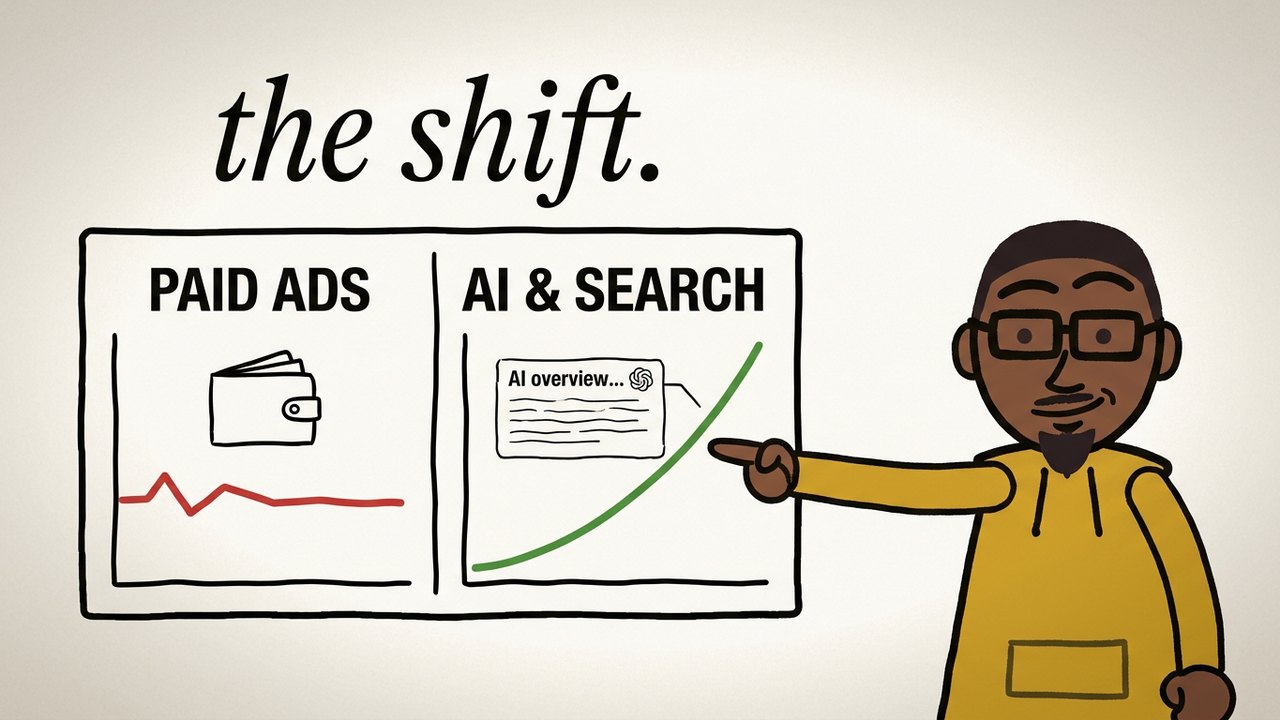
Most reports add the two together. So when fewer people search for your name, the total drops, and it looks like the SEO stopped working, even while more people found you without searching your name.
What did this look like for one dental group?
One multi-location dental group I work with is a clear example. I compared the same three months a year apart, August to October 2025 against August to October 2026, in the group's own Google Search Console.
- Total clicks fell 12.5%. On its own, that reads as a loss.
- Searches for the group's own name brought 19% fewer clicks.
- Searches without its name brought 37% more clicks, 391 against 285.
- Average position on those non-branded searches went from 41.8 to 20.2.
Same group, same months. If I had reported the total, the story would have been "down 12.5%." Split by name, the story is that people who didn't search its name were finding the group more often than a year before, while fewer people searched for it by name. Those are two different problems, with two different fixes.
How do you check this yourself in Search Console?
If paid or email traffic moved too, check those in Analytics first; this split is for search.
- Open Google Search Console and go to Performance, then Search results.
- Filter by branded and non-branded queries. Google's notes on this filter: it isn't available for sub-properties or for sites with a low number of impressions, and its data starts on March 11, 2025.
- If you don't see that filter, use a query filter instead: queries not containing your name. Add the short forms and common misspellings of your name too, or some branded searches will slip into the other pile.
- Compare the same months a year apart, not this month against last month. Seasons move search for almost every business, and a year-apart comparison cancels that out.
- Look at clicks and average position for each pile on its own.
If the branded pile fell and the non-branded pile held or grew, your SEO isn't what dropped.
What if non-branded searches fell too?
Then it's worth a closer look, and two more things are worth checking before anyone calls it a failure.
A lower average position can mean you're showing up for more. On one deep-tech company's new pages, average position moved from 6.2 to 9.6 while impressions grew roughly fivefold. The pages had started appearing for a far wider set of searches, including harder terms where a first appearance ranks lower. The pages are reaching further.
An AI answer may be answering the question above the results. In one client's case, a blog post had plenty of impressions and hardly any clicks in search, but AI answers kept citing it. Cutting it for low clicks would have removed something AI was quoting. Fewer clicks can mean the answer was given on the results page, with your page as the source.
One thing to try this week
Run the split in step 2 or step 3 above for the last three months against the same three months last year. Write down four numbers: branded clicks and non-branded clicks, then and now.
If you've done the split and still can't tell what moved, I'll read it with you.
Questions people ask
Why is my SEO not working?
It may be working. Split your clicks into searches that include your name and searches that don't, and compare the same months a year apart. SEO mostly moves the searches without your name. If those held or grew, the drop came from fewer people searching for you by name.
Why did my website traffic drop?
Check four things in this order. First, that your analytics is still recording: a broken tracking tag can look like a drop. Second, whether fewer people searched for your name. Third, whether your pages started showing for wider, harder searches, which lowers average position. Fourth, whether AI answers are answering the question on the results page and citing you.
Does a lower average position mean my SEO got worse?
Not always. When pages start appearing for many more searches, including harder ones, the average drops even as impressions grow. On one deep-tech company's new pages, average position went from 6.2 to 9.6 while impressions grew roughly fivefold.
More on SEO and AI search
Want this working on your business?
Tell me about your business and I'll come back with a candid read.